

If you’ve been injured and can barely make it from the car park to the front door without pain, you may be entitled to a disability parking permit – even if your injury is temporary. Most people Googling “how to get a disability parking permit in Queensland” assume the scheme is only for people with permanent disabilities or elderly Australians. It isn’t. Injured Queenslanders recovering from fractures, surgeries, whiplash and soft-tissue damage qualify every day, and the permit is free.
This guide walks you through exactly who’s eligible, how to apply, the lesser-known injuries that qualify, and just as importantly, what to do if your injury was caused by someone else’s negligence.
Quick answer: To get a disability parking permit in Queensland after an injury, you must be a Queensland resident whose ability to walk is severely restricted by a medical condition expected to last six months or more. Your GP or occupational therapist certifies the application. It’s free, takes about 28 days, and can be temporary or permanent.
📞 Injured and not sure where to start? Call Roche Legal’s Brisbane office on 1300 335 334 for a free, no-obligation chat. We help injured people across Brisbane, Logan and the Sunshine Coast every week.
What the disability parking permit actually does
The Australian Disability Parking Permit lets you use designated disability bays and gives you extra concessions in standard parking across Queensland and the rest of Australia. Permits are issued free of charge by the Department of Transport and Main Roads. Temporary permits run for six to twelve months. Longer-term permits are issued where your condition is expected to last beyond a year.
For someone recovering from a serious injury, the permit can be the difference between being able to attend physio, medical appointments, work and shopping – and being stuck at home.
Eligibility – it’s about function, not diagnosis
According to the Queensland Government’s disability parking permit page, you can apply if you are a Queensland resident and your ability to walk is severely restricted by:
- a permanent medical condition, or
- a temporary medical condition, or
- a disability you will have for six months or more, as certified by your health professional.
You also qualify if you’re unable to walk without a wheelchair, or you’ve been diagnosed as legally blind.
The phrase that matters is “severely restricted”. This is a functional test, not a label test. Your diagnosis doesn’t have to be exotic. Your injury doesn’t have to be permanent. What matters is the impact on your walking, and whether your doctor or OT is willing to certify it.
📞 Not sure if your injury meets the threshold? Speak to your GP – and if your injury was caused by an accident, call Roche Legal on 1300 335 334. We’ll tell you in plain English whether you may also have a compensation claim.
Injuries that commonly qualify – but people don’t realise
In our work with injured clients across Brisbane, Logan and the Sunshine Coast, we regularly see people who never thought to apply because they assumed permits were “for someone else”. Here are the injuries we most often see qualify:
Lower limb fractures
A fractured tibia, femur, ankle or foot – particularly when you’re non-weight-bearing or partially weight-bearing in a moon boot, brace or cast – easily meets the six-month threshold once you factor in surgery, slow union, or rehab. If your fracture happened in a car accident, at work, or because of someone else’s negligence, you may also be entitled to compensation that covers your treatment and lost income – see our motor vehicle accidents and workers’ compensation practice areas.
Post-surgical recovery
ACL reconstructions, meniscal repairs, hip replacements following a fall, spinal fusions, and shoulder surgeries that prevent you using crutches or a frame all commonly qualify during the recovery period.
Soft tissue injuries with chronic pain
A serious back injury, ruptured Achilles or torn rotator cuff that prevents normal gait or balance is regularly certified by GPs as severely restricting mobility – no plaster cast required.
Whiplash and cervical spine injuries
Severe neck injuries from rear-end collisions can affect balance, head movement and proprioception enough to make walking through busy car parks dangerous. Whiplash is one of the most under-claimed injuries we see – many people don’t realise they have a CTP claim. Read more on our motor vehicle accidents page.
Complex Regional Pain Syndrome (CRPS)
Often triggered by what seemed like a minor injury, CRPS causes debilitating pain in a limb for months or years and is widely recognised as a qualifying condition.
Traumatic brain injury and post-concussion syndrome
Where balance, dizziness or vestibular symptoms make walking distances unsafe, a permit is appropriate. Brain injuries – even “mild” ones – often have life-long consequences. If yours was caused by a fall, accident or assault, please see our [public liability] page.
Burns and grafting injuries
Significant lower-limb burns or skin grafts that limit walking during healing and rehab.
Crush injuries and amputations
Including partial foot amputations and degloving injuries – common in industrial and workplace accidents.
“But I’m not really disabled” – the most common reason people don’t apply
We hear this constantly. People worry they’re “taking a permit from someone who needs it more”. That’s not how the scheme works. The permit exists for exactly your situation – a person whose walking is genuinely restricted by injury. Your GP’s reception sees these forms every week. A temporary permit isn’t a label; it’s a recovery aid. If you’re hesitating, ask yourself: would walking 300 metres from a regular car park cause you significant pain or risk a fall today? If yes, you qualify for the conversation – let your doctor decide on the certification.
How to apply for a disability parking permit in Queensland
You can apply online, in person at a transport and motoring customer service centre, or by post.
For a mobility impairment, your doctor or occupational therapist completes Part 2 (Medical details) of the Australian Disability Parking Permit – Mobility Impairment Application (Form F4814) if:
- you don’t already have a permit, or
- your previous permit expired more than three months ago, or
- you currently hold a temporary permit (six to twelve months).
You complete Part 1 (Applicant details) yourself.
Online: scan and attach the medical certification when submitting the application.
By post: Department of Transport and Main Roads, Disability Parking Permit Scheme, PO Box 525, Fortitude Valley QLD 4006.
You’ll receive a decision within approximately 28 days.
What if your application is refused?
Most refusals come down to vague medical evidence – for example, a certificate that lists your diagnosis but doesn’t comment on how severely your walking is restricted. You have 28 days to request a review using Form F3859. A more detailed letter from your GP, surgeon, or treating occupational therapist is usually enough to reverse the decision.
If your injury was caused by someone else – you may have a claim worth pursuing
A disability parking permit helps you get through the day. A compensation claim helps you put your life back together. If your injury happened in any of the following circumstances, you should speak to a personal injury lawyer before signing anything with an insurer:
- A motor vehicle accident, even as a passenger, cyclist or pedestrian
- At work or travelling to/from work
- In a shop, public place, rental property or someone else’s home
- As a result of a medical procedure that went wrong
- On a worksite as a contractor or visitor
Compensation in Queensland can cover medical treatment, rehabilitation, lost income (past and future), home and vehicle modifications, care and assistance, and the pain and impact of the injury itself.
What might my claim be worth?
Try our Queensland Compensation Calculator. It takes a couple of minutes and gives a plain-English estimate of what compensation can include, such as pain and suffering, lost income, super, care and out-of-pocket expenses.
It’s an estimate only (not legal advice), but it can help you get a sense of what your claim may be worth before you decide what to do next.
Most personal injury matters at Roche Legal are handled on a no-win no-fee basis, with a free initial consultation.
Visiting Roche Legal: designated disability parking at our Springwood office
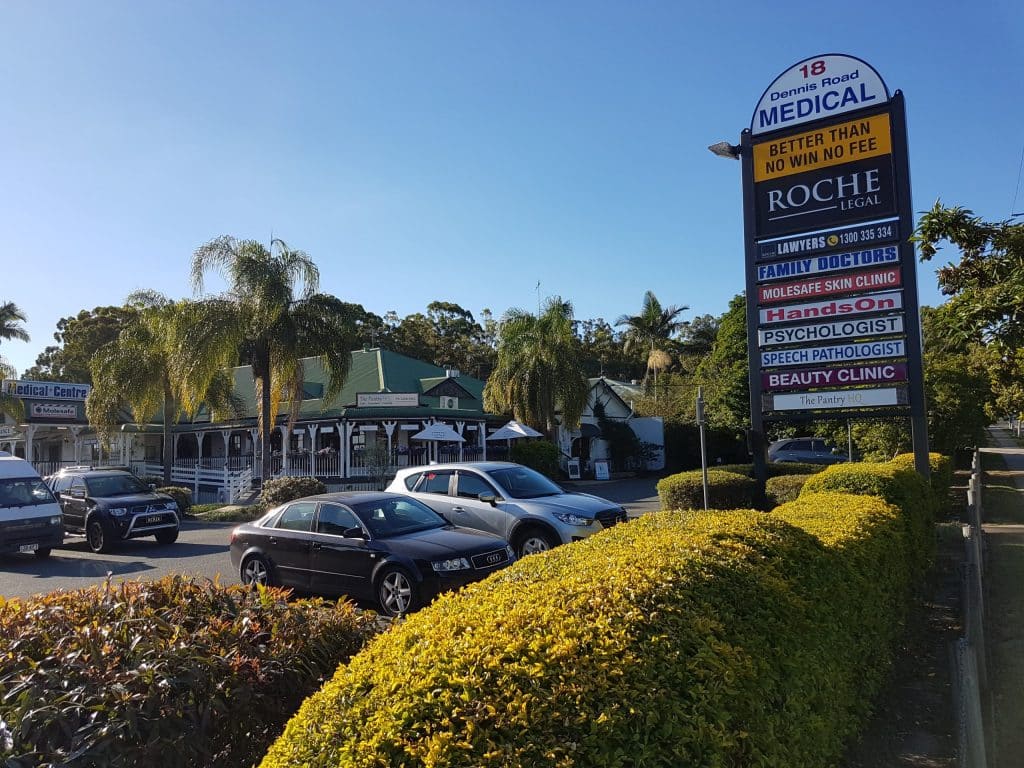
We know getting to a legal appointment after an injury can be one of the hardest parts of your day. That’s why our Springwood office has designated disability parking spaces reserved for our clients, located directly outside our front entrance. Temporary or permanent permit – you’re welcome to use them anytime you visit.
Frequently asked questions
Yes. If your injuries severely restrict your ability to walk for six months or more, your GP can certify the application. Many of our motor vehicle accident clients hold a temporary permit during their recovery.
Often, yes – particularly where you’re non-weight-bearing, in a moon boot or brace, or recovering from surgery. Your treating doctor decides whether your walking is severely restricted.
Temporary permits are issued for six to twelve months. Longer-term permits are issued where your condition is expected to last beyond that period.
The Department of Transport and Main Roads aims to decide applications within approximately 28 days of receipt.
Nothing. The permit itself is issued free of charge by the Queensland Government.
Possibly. If your injury was caused by someone else’s negligence, transport and parking costs incurred for medical treatment are often recoverable as part of a personal injury claim. Speak to a lawyer before agreeing anything with an insurer.
Talk to Roche Legal today
If you’ve been injured and you think you may have a compensation claim, the most valuable thing you can do today is have a free, no-obligation conversation with a personal injury lawyer who knows Queensland law inside out.
📞 Call Roche Legal Brisbane on 1300 335 334 – or fill out your details on our contact form and we’ll call you back the same business day.